A DVA Arrival declaration is the arrival notification in NCTS: you report that the goods of a transit declaration have arrived at the office of destination. You refer to the transit declaration with its MRN. This article follows the screens of the notification in Shipment. For each screen you see which JSON field fills which field. The column Field in Shipment shows the section and the label as you see them on the screen, with the number from the screenshot.
How declarations and dossiers work in general is in the article Customs.
| Endpoint | POST /erpservices/ImportDossier |
| Where in the request | dvaArrivalDeclarations (array) |
| One request | One dossier, maximum 10 declarations per request in total. |
DeclarationType in status updates |
8 |
| Reference in the response | frn |
Downloads
- Download - DVA Arrival (.json)
- Download - NCTS phase 5 code tables, 09-07-2024 (.zip)
- Download - NCTS-P5 code list extract, 2024-05-21 (.xml)
Endpoint
POST {base-url}/erpservices/ImportDossier
Replace {base-url} with the URL of your product and environment:
| Product and environment | {base-url} |
| Stratech Shipment – Test | https://test-{prefix}.shipment-stratech.nl |
| Stratech Shipment – Production | https://{prefix}.stratechshipment.nl |
| Beurtvaartadres ShipmentManager – Test | https://{prefix}.accshipmentmanager.eu |
| Beurtvaartadres ShipmentManager – Production | https://{prefix}.shipmentmanager.eu |
Structure
The request is a dossier with the declaration in the array dvaArrivalDeclarations. The paths in the tables below start at one item of that array.
How to read the tables
The column Req. shows what the API requires: ✓ means the request is rejected without the field. Default means Shipment fills in that value when you leave the field out. Which fields Customs requires depends on the type of declaration; those rules are in the MIG (see Downloads). Shipment checks them when it validates the declaration. The number before a label is the number in the screenshot.
Control fields
| Field in Shipment | JSON field | Type | Req. | Description |
| – | applicationReferenceId |
string |
✓ | Your unique reference for this declaration. Never reuse it, not even when you send the same dataset again. A duplicate returns HTTP 409. |
| – | doSubmitWhenValid |
boolean |
Default false. true: Shipment submits the declaration to Customs as soon as it is valid. |
|
| – | doNotSaveWhenInvalid |
boolean |
Default false: an invalid declaration is saved, so a user can complete it in Shipment. true: an invalid declaration is not saved and you get the errors back. |
|
| – | fullUserNameOfSubmitter |
string(64) |
Full name of the user who submits the declaration. |
Step 1: Aangifte (Declaration)
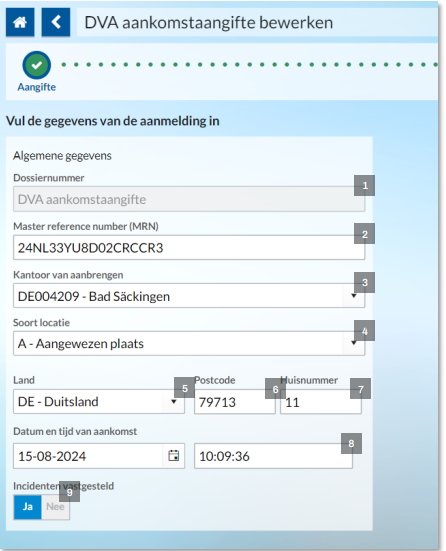
Algemene gegevens
Path: declarationData
| Field in Shipment | JSON field | Type | Req. | Description |
| 1. Dossiernummer | dossierNumber |
string(30) |
✓ | At the top of the request, outside the declaration: dossierNumber. The dossier name in Shipment, for example your order or delivery number. |
| 2. Master reference number (MRN) | mrn |
string(18) |
✓ | MRN of the transit declaration that arrives. |
| 3. Kantoor van aanbrengen | customsOfficeOfDestinationActualReferenceNumber |
string(8) |
Customs office where the goods are presented (actual office of destination). Code list CL172. |
Locatie goederen
Path: declarationData.goodsLocation
| Field in Shipment | JSON field | Type | Req. | Description |
| 4. Soort locatie | type |
string(1) |
Type of location. Code list CL347. | |
| 5. Land | country |
string(2) |
Country. Code list CL190. | |
| 6. Postcode | postcode |
string(17) |
Postal code. | |
| 7. Huisnummer | houseNumber |
string(17) |
House number. |
Aankomst
Path: declarationData
| Field in Shipment | JSON field | Type | Req. | Description |
| 8. Datum en tijd van aankomst | arrivalNotificationDateAndTime |
datetime |
Date and time of arrival. | |
| 9. Incidenten vastgesteld | hasIncidents |
boolean |
Phased out: this field is not sent to Customs. |
Step 2: Aanbrenger (Trader at destination)
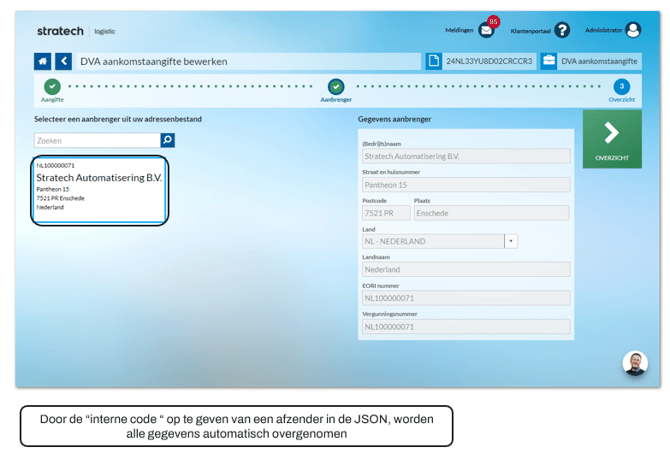
| Field in Shipment | JSON field | Type | Req. | Description |
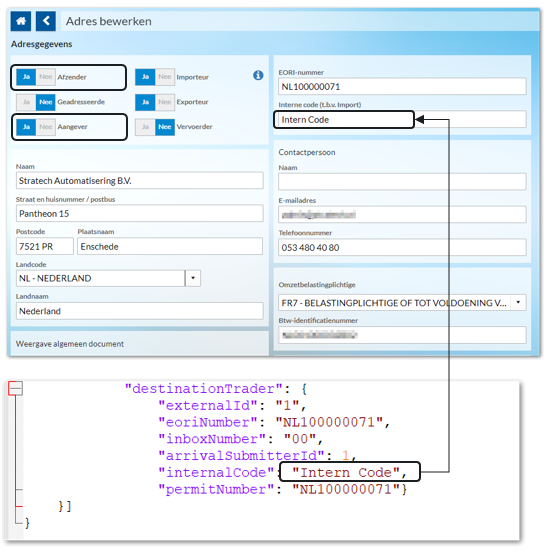
| Aanbrenger > EORI-nummer | destinationTrader.eoriNumber |
string |
✓ | EORI number of the trader at destination who presents the goods. |
Response
The response has one result per notification in dvaArrivalDeclarationResults: applicationReferenceId, isSaved, isSubmitted, errors and frn. HTTP 200 does not mean every notification is valid: always check isSaved and errors. All HTTP codes are in the article Payload rules.
Points to note
- Code list fields must contain the exact code from the Customs code list. See the article Code lists. The NCTS phase 5 code tables are in Downloads.
hasIncidentsis phased out and is not sent to Customs. You can leave it out.