An e-Balie export notification reports the export documents of containers to e-Balie, the port system of the Belgian ports.
This article follows the screen of the notification in Shipment.
For each field you see which JSON field fills it.
Shipment can also create an e-Balie notification from a DMS Export declaration.
How that works, and how port notifications work in general, is in the article Port notifications Overview.
Downloads
| Endpoint | POST /erpservices/ImportDossier |
| Where in the request | eBalieExportNotifications (array) |
| One request | One dossier, maximum 10 messages per request in total. |
DeclarationType in status updates |
15 |
| Reference in the response | None. The result has no reference number. |
Endpoint
POST {base-url}/erpservices/ImportDossier
Replace {base-url} with the URL of your product and environment:
| Product and environment | {base-url} |
| Stratech Shipment – Test | https://test-{prefix}.shipment-stratech.nl |
| Stratech Shipment – Production | https://{prefix}.stratechshipment.nl |
| Beurtvaartadres ShipmentManager – Test | https://{prefix}.accshipmentmanager.eu |
| Beurtvaartadres ShipmentManager – Production | https://{prefix}.shipmentmanager.eu |
Structure
The request is a dossier with the notification in the array eBalieExportNotifications. The paths in the tables below start at one item of that array.
Each container is one item in notificationData.equipment, with its documents in documents.
"notificationData": {
  "bodyType": "CONT",
  "equipment": [ { "number": "AGKU5325760", "documents": [ { "documentNumber": "...", "code": "EX" } ] } ]
}
How to read the tables
The column Req. shows what the API requires: ✓ means the request is rejected without the field.
Which other fields are needed depends on the message; Shipment checks that when it validates the message.
The column Field in Shipment shows the section and the label on the screen, in Dutch with the English in parentheses.
Control fields
| Field in Shipment | JSON field | Type | Req. | Description |
| – | applicationReferenceId |
string |
✓ | Your unique reference for this notification. Never reuse it, not even when you send the same dataset again. A duplicate returns HTTP 409. |
| – | doSubmitWhenValid |
boolean |
Default false. true: Shipment sends the notification to e-Balie as soon as it is valid. |
|
| – | doNotSaveWhenInvalid |
boolean |
Default false: an invalid notification is saved, so a user can complete it in Shipment. true: an invalid notification is not saved and you get the errors back. |
|
| – | fullUserNameOfSubmitter |
string(64) |
Full name of the user who submits the notification. |
e-Balie melding (e-Balie notification)
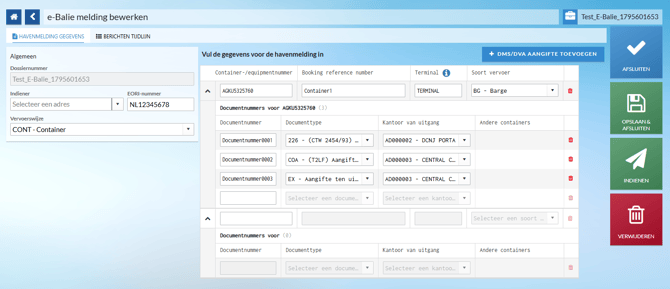
Algemeen (General)
| Field in Shipment | JSON field | Type | Req. | Description |
| Dossiernummer (Dossier number) | dossierNumber |
string(30) |
✓ | At the top of the request, outside the notification: dossierNumber. The dossier name in Shipment, for example your order or delivery number. |
| Indiener (Submitter) | notificationData.submitter.internalCode |
string(450) |
Internal code of the submitter in the address book. | |
| EORI-nummer (EORI number) | notificationData.submitter.eoriNumber |
string(50) |
EORI number of the submitter. If you fill it in, Shipment ignores internalCode. |
|
| Vervoerswijze (Mode of transport) | notificationData.bodyType |
string(4) |
Mode of transport: CONT (container), RORO (roll-on/roll-off) or FRRY (ferry). |
|
| – | functionalReference |
string |
Functional reference of the notification. Not shown on this screen [VERIFY: what to send]. |
Havenmelding (Port notification)
Path: notificationData.equipment[]
| Field in Shipment | JSON field | Type | Req. | Description |
| Container-/equipmentnummer (Container/equipment number) | number |
string(17) |
Container or equipment number. One item in equipment per container. |
|
| Booking reference number | bookingsReference |
string(35) |
Booking reference of the container. | |
| Terminal | terminal |
string(15) |
Terminal where the container is delivered. | |
| Soort vervoer (Carrier type) | carrierType |
string(2) |
How the container arrives at the terminal: BG (barge), RL (rail), TR (truck) or VS (vessel). |
Documentnummers (Document numbers)
Path: notificationData.equipment[].documents[]
| Field in Shipment | JSON field | Type | Req. | Description |
| Documentnummer (Document number) | documentNumber |
string(18) |
Number of the customs document, for example the MRN. One item in documents per document. |
|
| Documenttype (Document type) | code |
string(3) |
Type of document: EX (export declaration), EXS (safety and security declaration), COA (T2LF, declaration of Union goods), T2L (proof of Union status), T (transit, T1/T2), TN (transhipment without release for free circulation) or 226 (simplified customs procedure, CTW 2454/93). |
|
| Kantoor van uitgang (Office of exit) | office |
string(8) |
Customs office of exit. Must be a valid EU customs office code, for example AD000002. |
|
| Andere containers (Other containers) | – | No JSON field. Shown by Shipment: other containers in this notification with the same document [VERIFY]. |
In Shipment the button DMS/DVA aangifte toevoegen (Add DMS/DVA declaration) adds the documents of a declaration in Shipment.
Through the API you send them in documents.
Response
The response has one result per notification in eBalieExportNotificationResults: applicationReferenceId, isSaved, isSubmitted, errors. HTTP 200 does not mean every notification is valid: always check isSaved and errors. All HTTP codes are in the article Payload rules.
Points to note
- Write field names exactly as in the tables, in camelCase:
applicationReferenceId, notApplicationReferenceId. - Use the same
dossierNumberas the export declaration the notification belongs to. - Leave out empty fields, for example
fullUserNameOfSubmitter: "".