A provisioning declaration (in Dutch: proviandering) reports the supply of goods to a sea vessel or aircraft through the Single Window. This article follows the screens of the declaration in Shipment. For each screen you see which JSON field fills which field.
How Single Window messages work in general is in the article Single Window Overview.
| Endpoint | POST /erpservices/ImportDossier |
| Where in the request | swProvisioningDeclarations (array) |
| One request | One dossier, maximum 10 declarations per request in total. |
DeclarationType in status updates |
14 |
| Reference in the response | frn |
Downloads
Endpoint
POST {base-url}/erpservices/ImportDossier
Replace {base-url} with the URL of your product and environment:
| Product and environment | {base-url} |
| Stratech Shipment – Test | https://test-{prefix}.shipment-stratech.nl |
| Stratech Shipment – Production | https://{prefix}.stratechshipment.nl |
| Beurtvaartadres ShipmentManager – Test | https://{prefix}.accshipmentmanager.eu |
| Beurtvaartadres ShipmentManager – Production | https://{prefix}.shipmentmanager.eu |
Structure
The request is a dossier with the declaration in the array swProvisioningDeclarations. The paths in the tables below start at one item of that array.
How to read the tables
The column Req. shows what the API requires: ✓ means the request is rejected without the field. Which other fields are needed depends on the message; Shipment checks that when it validates the message. The column Field in Shipment shows the section and the label on the screen, in Dutch with the English in parentheses. The number before a label is the number in the screenshot.
Control fields
| Field in Shipment | JSON field | Type | Req. | Description |
| – | applicationReferenceId |
string |
✓ | Your unique reference for this declaration. Never reuse it, not even when you send the same dataset again. A duplicate returns HTTP 409. |
| – | doSubmitWhenValid |
boolean |
Default false. true: Shipment submits the declaration as soon as it is valid. |
|
| – | doNotSaveWhenInvalid |
boolean |
Default false: an invalid declaration is saved, so a user can complete it in Shipment. true: an invalid declaration is not saved and you get the errors back. |
|
| – | fullUserNameOfSubmitter |
string(64) |
Full name of the user who submits the declaration. |
Step 1: Aangifte (Declaration)
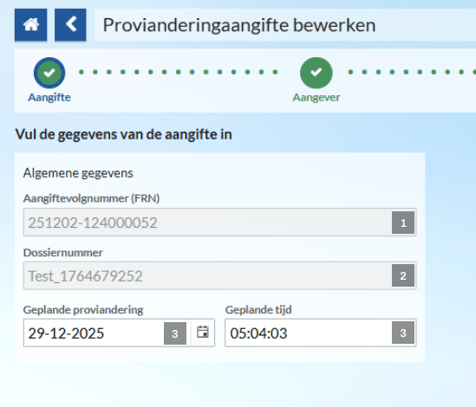
Aangifte (Declaration)
| Field in Shipment | JSON field | Type | Req. | Description |
| 1. Aangiftevolgnummer (FRN) | – | No JSON field. Generated by Shipment. Returned in the response as frn. |
||
| 2. Dossiernummer (Dossier number) | dossierNumber |
string(30) |
✓ | At the top of the request, outside the declaration: dossierNumber. The dossier name in Shipment, for example your order or delivery number. |
| 3. Geplande proviandering, datum en tijd (Planned provisioning, date and time) | declarationData.borderTransportMeansPortActivity |
datetime |
Planned date and time of the provisioning. |
Step 2: Aangever (Declarant)
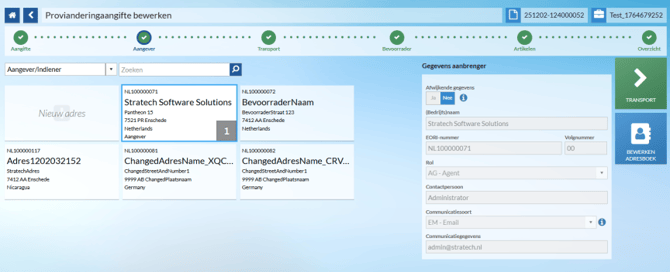
| Field in Shipment | JSON field | Type | Req. | Description |
| Aangever (Declarant) > EORI-nummer (EORI number) | declarant.eoriNumber |
string(17) |
✓ | EORI number of the declarant. Shipment takes the address details from the address book. |
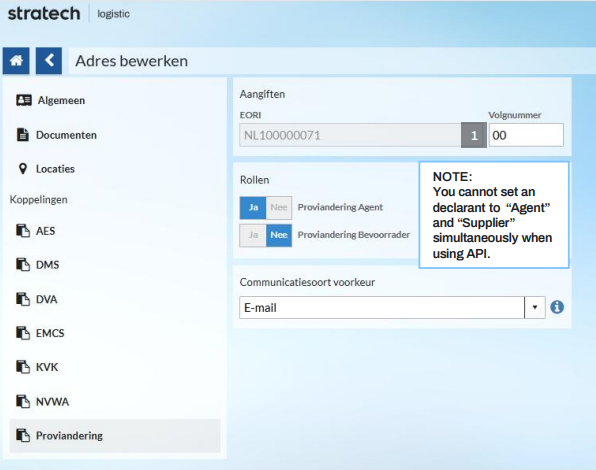
In Shipment, a declarant cannot be agent and supplier at the same time when the declaration comes from the API.
Step 3: Transport
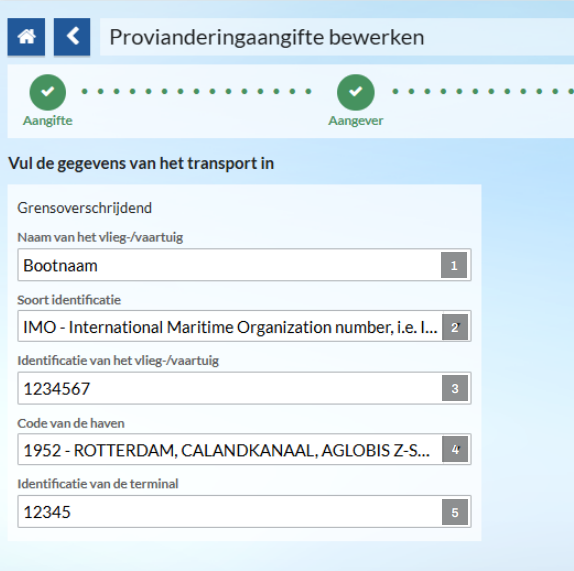
Grensoverschrijdend vervoermiddel (Border transport means)
Path: declarationData
| Field in Shipment | JSON field | Type | Req. | Description |
| 1. Naam van het vlieg-/vaartuig (Name of aircraft or vessel) | borderTransportMeansName |
string(70) |
Name of the aircraft or vessel. | |
| 2. Soort identificatie (Type of identification) | borderTransportMeansIdentificationType |
string(17) |
Type of identification of the aircraft or vessel (code list M03). | |
| 3. Identificatie van het vlieg-/vaartuig (Identification) | borderTransportMeansIdentification |
string(25) |
Identification of the aircraft or vessel. | |
| 4. Code van de haven (Port code) | borderTransportMeansDepartureConveyanceIdentification |
string(35) |
Code of the port. | |
| 5. Identificatie van de terminal (Terminal) | borderTransportMeansStay |
string(35) |
Identification of the terminal. |
Step 4: Bevoorrader (Ship chandler)
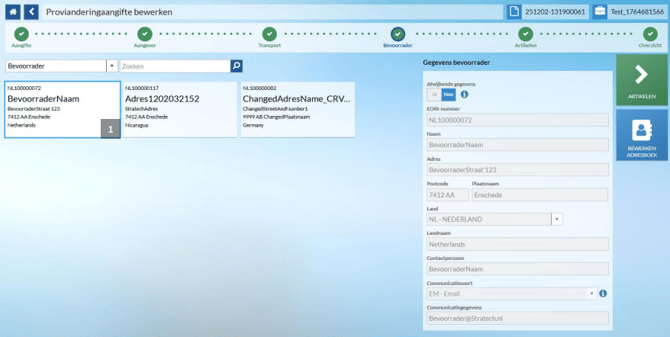
| Field in Shipment | JSON field | Type | Req. | Description |
| Bevoorrader (Ship chandler) > Interne code (Internal code) | shipChandler.internalCode |
string(450) |
✓ | Internal code of the ship chandler in the address book. Shipment takes all address details from it. |
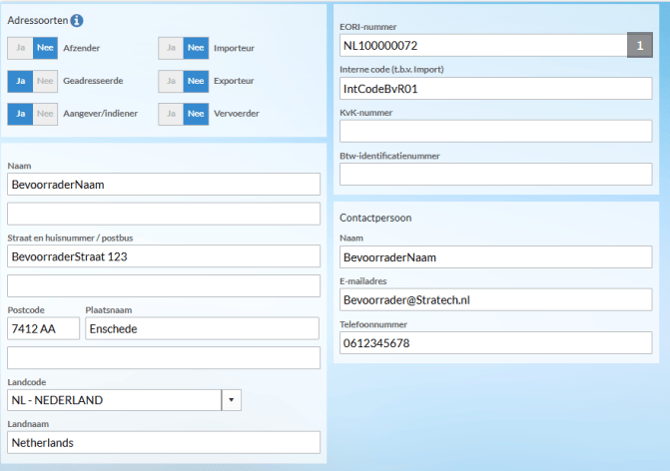
Step 5: Artikelen (Goods items)
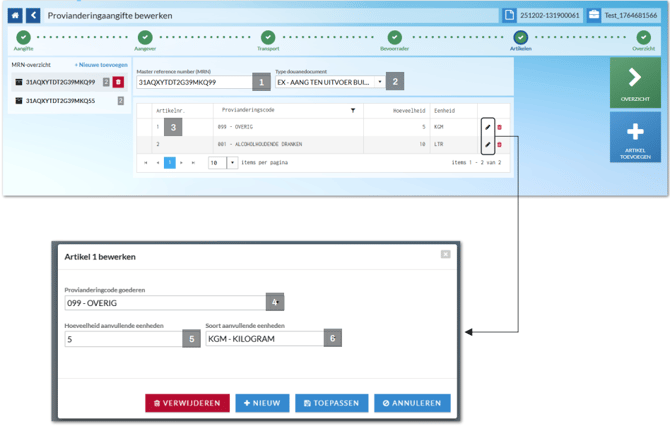
Douanedocument (Customs document)
Path: declarationData.goodsShipments[]
| Field in Shipment | JSON field | Type | Req. | Description |
| Volgnummer (Sequence number) | sequenceNumber |
integer |
✓ | The sequence number starting from 1 incremented by 1 for every item. |
| 1. Master reference number (MRN) | additionalDocument.identification |
string(70) |
MRN of the customs document. | |
| 2. Type douanedocument (Type of customs document) | additionalDocument.type |
string(3) |
Type of the customs document (code list A28). |
Artikel (Goods item)
Path: declarationData.goodsShipments[].governmentAgencyGoodsItems[]
| Field in Shipment | JSON field | Type | Req. | Description |
| 3. Artikelnummer (Item number) | sequenceNumber |
integer |
✓ | Item number, starting at 1 and increasing by 1 for every item. |
| 4. Provianderingcode goederen (Provisioning goods code) | commodity.classificationIdentification |
string(18) |
Provisioning code of the goods (code list N88). | |
| 5. Hoeveelheid aanvullende eenheden (Quantity in supplementary units) | goodsMeasure.tariffQuantity |
number |
Quantity in supplementary units. | |
| 6. Soort aanvullende eenheden (Supplementary unit) | goodsMeasure.tariffUnitCode |
string(3) |
Code of the supplementary unit. |
Step 6: Overzicht (Overview)
The last screen shows a summary of the declaration. It has no fields of its own.
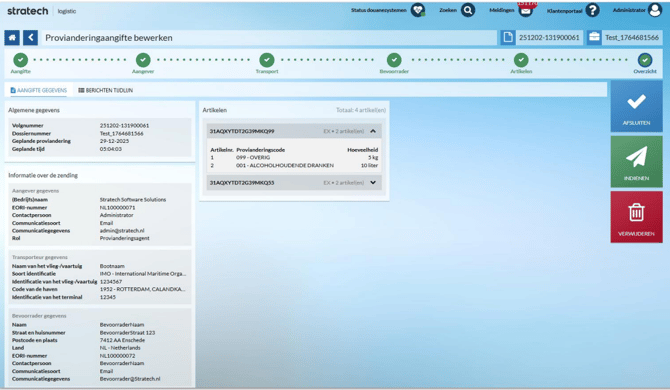
Response
The response has one result per declaration in swProvisioningDeclarationResults: applicationReferenceId, isSaved, isSubmitted, errors and frn. HTTP 200 does not mean every declaration is valid: always check isSaved and errors. All HTTP codes are in the article Payload rules.
Points to note
- The declarant and the ship chandler must be in the address book. Shipment takes their details from it.
- Number the goods shipments and the items within each goods shipment from 1, increasing by 1.